The Queer Liberation March is an annual march for socialism and queer liberation organized by a coalition of several socialist organizations in the Madison area.
Announcements 
2026 QLM Retrospective
2026-07-17Our second annual Queer Liberation March this past June was a great success. We marched for our rights down Willy street and around the Capitol Square. We spoke out against the injustices that still face queer people across the country and in our very state. We met with each other, we shared our common struggles, and we grew as a community.
Now we want to look back on the march, celebrate our successes, highlight some lessons learned, and emphasize our goals moving forward.
First and foremost, we stayed safe. Our marshalling team successfully guided us down busy streets, across high traffic intersections, and through a densely populated farmers market all while sustaining no injuries. We even marched through Madison's "Safety Saturday" - a yearly event that hosts several Madison municipal services, including several police departments - without any incidents. We protested police occupation right to their faces and stayed safe while doing so.
We heard some really great speeches from community members. Emma from the Trans Resistance Action Committee called on us to protect trans youth. They spoke about UW Health's recent decision to discontinue gender affirming care for minor patients. Vi, a member of the Party for Socialism and Liberation, focused on empowering queer workers, highlighting the disastrous Act 10 and "Right to Work" laws in Wisconsin. Milcah from Freedom Inc closed us out by shouting out our need to defend our bodily autonomy at the steps of the state capitol.
We even had some candidates for office take notice of the march and joined in our struggle. Former Alder Juliana Bennett, who is running for state assembly district 76, joined the march to support our rights and to show solidarity.
We as a planning committee have also reflected on how we want to improve the march in the future. Our greatest ambition is to build the march into a mass movement. This would involve many more organization endorsements and contributions as well as an increase in the number of people participating in the march. In particular, we'd like to get unions like MTI, UFAS, UE, and others involved in planning the march and spreading the word to their members.
We also realized this time around that the march moved at a quick pace. In some ways, that's good. A quick pace keeps our energy up and our marchers engaged. But we need to be careful not to stretch the march out or leave anyone behind.
As we look forward to future action, including our Fall fundraiser and next year's march, we have a number of goals we are looking to achieve. As always, our primary goal is to get people organized. We encourage every person attending our marches to join one of the organizations that helped to make it happen. All of these organizations are working to further the socialist causes we stand for, including protecting trans youth, empowering queer workers, and providing healthcare for all.
Through these organizations as well as individual efforts from each of us, we seek to pressure elected officials, healthcare organizations, and our individual workplaces to create laws, provide services, and administer working conditions that promote justice, safety, and equality for queer workers alongside all marginalized peoples.
One specific goal we want to keep in our sights is resumption of gender affirming care for minors through healthcare organizations like UW Health, Children's Hospital, and Froedtert. This was a recent rollback of healthcare rights in our state that were a direct result of the Trump administration's illegal attempt to block federal funding for hospitals that provide this care. We have pressured UW Health specifically to at least justify their "pause" in providing this care when a judge has already ruled that this secession of funds is illegal. We also directly asked our elected officials what they will do to secure these rights for trans youth moving forward.
Finally, we want to ensure that each and every participant in the Queer Liberation March understands that these marches are never the end, they are the beginning. The goal of these marches is not just to make our voices heard. The goal is to bring us all together into a community of queer people and allies to advocate for our rights together.
We can't wait to plan and host our fundraiser later this Fall and the next March in June 2027.
Solidarity Forever,
Queer Liberation March Planning Committee
Announcing the 2026 Queer Liberation March!
2026-05-04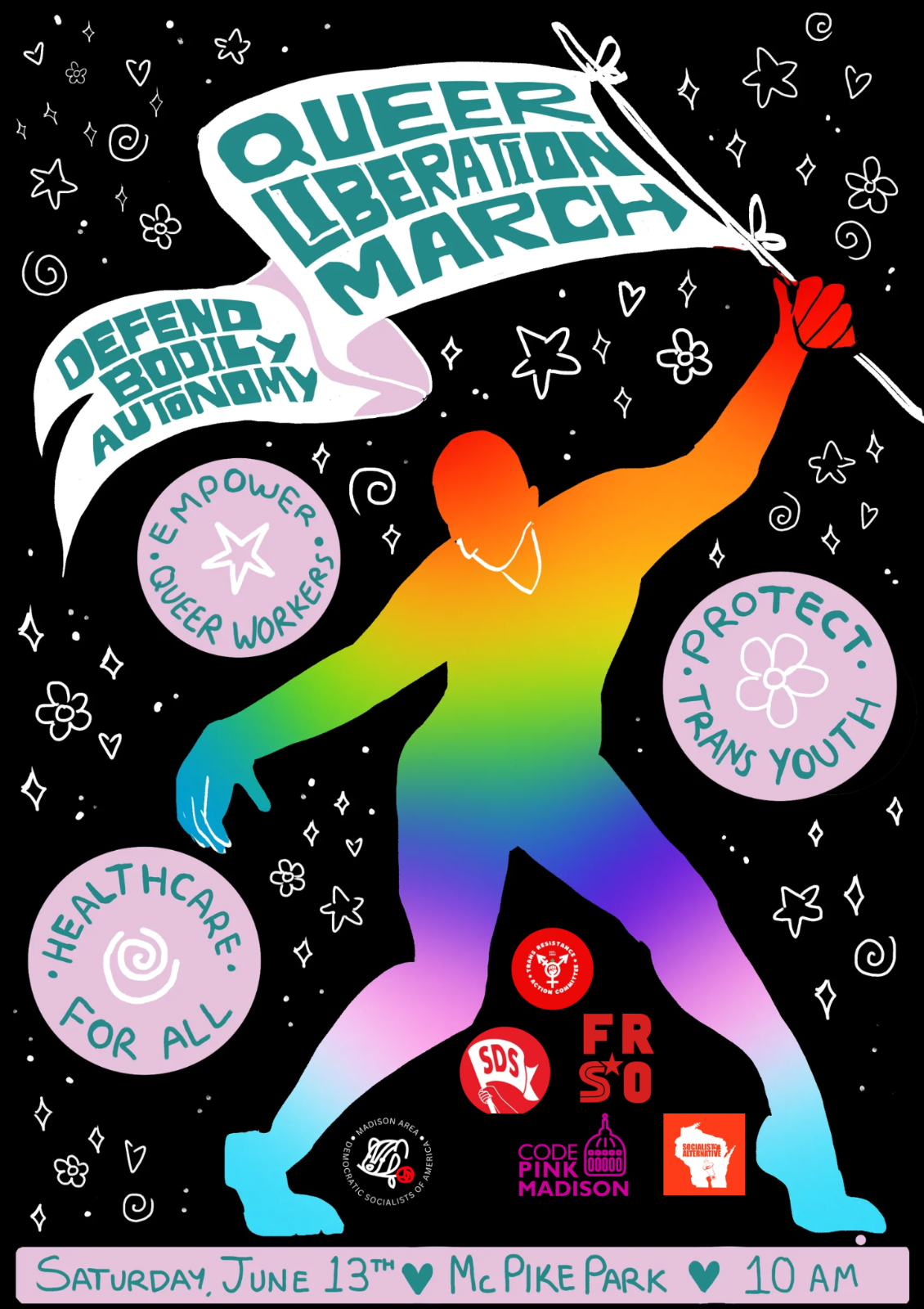
The 2nd annual Madison Queer Liberation March will be happening on June 13, 2026. Starting at 10 AM at McPike Park, we will march to the capitol with the following demands to Defend Bodily Autonomy.
Protect Trans Youth
Trans youth in the United States are constantly under attack. Just in the last year, several bills were introduced in the Wisconsin legislature attacking trans youth's right to exist and be equal members of society. This ranges from attacking their access to youth sports (AB 100, AB 102) to requiring deadnaming in schools (AB 103) to preventing healthcare organizations from providing lifesaving care to minors (AB 104). While these bills are consistently vetoed by our liberal governor, we need to be proactive in passing legislation that protects trans youth from further attacks on their rights.
We need to hold our healthcare institutions accountable to provide comprehensive patient care. In response to unlawful political pressure from the U.S. Department of Health and Human Services (HHS), Wisconsin healthcare organizations including UW Health and Children’s Hospital of Wisconsin "paused" gender-affirming care services to minor patients. Even today, despite a federal judge ruling that HHS's actions were unlawful, these institutions still do not offer this necessary care to their patients. They are afraid of losing essential Medicare and Medicaid funding from this tyrannical federal administration. We cannot allow fear to drive these organizations to harm their patients.
We need to fund queer-inclusive sexual health education in our schools. Currently, the only requirement for sex-ed in Wisconsin is STI instruction. There is no requirement to provide information on human growth and development. However, if a school wants to discuss the topic, then they must stress abstinence with no other instruction being necessary. Instruction on gender identity, sexual orientation, and consent is encouraged by the Department of Public Instruction, but is not mandated for any school. This is an unacceptable gap in public education that needs to be filled by giving qualified educators and social workers the training and support they need to support queer and trans youth.
Healthcare for All
Healthcare, including access to gender-affirming care, is a human right. Our for-profit insurance system is a cruel and extractive process that cuts off patients from the healthcare they need. Dismantling this system will be a long arduous journey. While there are proposals, like the BadgerCare Public Option that could widen healthcare options for some people, and we would generally support their passage, universal healthcare which is free at the point of use is the goal. Not only is it the most humane option, it is also the least expensive, as evidenced by every country that has implemented it.
We need to protect and expand reproductive healthcare access across the state. Currently, there are only five clinics throughout the state that perform abortion services, mostly concentrated in the southeast portion of the state. Ever since the Dobbs ruling, access has only gotten more difficult. While the Wisconsin Supreme Court rejected the original 1849 ban on abortions, several obstacles still remain. Wisconsin does not allow state, local, or federal funding for programs that provide or promote abortion services or referrals. Wisconsin law also requires that physicians provide counseling in-person at least 24 hours prior to the procedure, requiring that the patient make at least two trips to the clinic to see the same exact provider, which is particularly burdensome for people that live far from available clinics. During the initial visit an ultrasound and fetal heartbeat, if present, must be shown to the patient, neither of which is medically necessary, and has its own separate costs. And finally, minors are required to gain parental consent before seeking an abortion, though they can obtain a waiver from a judge. We need to repeal every last one of these unnecessary laws and expand access to these vital services by making it easier for clinics to provide and refer patients for abortion services.
We need to end HIV stigmatization and criminalization. HIV PrEP (Pre-Exposure Prophylaxis) and PEP (Post-Exposure Prophylaxis) medications are incredibly effective at preventing HIV transmission. PrEP is 99% effective at preventing HIV acquisition, but only 22% of individuals who could benefit from the medication are prescribed it. Despite no evidence that it promotes public safety, people living with HIV have been criminalized in the state of Wisconsin, including for acts like spitting on a person, which does not confer risk of transmission. We need to modernize Wisconsin’s laws, expand access to treatment options, and help end the still-ongoing HIV epidemic.
Empower Queer Workers
Former Governor Scott Walker and his administration did unmatched damage to the labor movement in Wisconsin, hurting our public and private sector workforces while increasing costs to taxpayers and worsening essential services to our communities. Act 10 was and still is one of the most disastrous pieces of legislation for Wisconsin workers. It effectively ended collective bargaining rights for tens of thousands of teachers, nurses, and other public employees. Even though a Dane county judge overturned the law in December 2024, the appellate courts and Wisconsin supreme court have stalled out the ruling for a year and a half with no end in sight. Workers are tired of waiting and we deserve to have our rights restored now.
Right-to-work, sometimes known as "right-to-work for less," is another terrible law passed under the Walker administration that permits workers to opt-out of paying union dues, even in unionized workplaces, ultimately limiting collective worker power. As a working class, we are only as strong as our bonds and solidarity with one another, which is why buy-in from all workers is so important. Both Act 10 and Right to Work need to be reversed in order for the Wisconsin working class to fully exercise their worker power. Additionally, Wisconsin’s prevailing wage law must be reinstated to ensure projects funded by taxpayer dollars lead to good-paying union jobs that enhance our communities, not extract from them.
Importantly for trans and non-binary workers specifically is the need to expand anti-discrimination protections to include gender-identity. Transgender and non-binary people in Wisconsin face higher levels of discrimination in the workplace and lower levels of full-time employment. Wisconsin was the first state nationally to ban workplace discrimination on the basis of sexual orientation when it amended the Wisconsin Fair Employment Act in 1982, but it now lags behind twenty-two other states that have expanded similar protections for gender identity. Although the recent U.S. Supreme Court ruling on the Bostock case has effectively expanded these protections at the federal level, the even more recent Dobbs case, which overturned Roe v. Wade, has shown us that relying on the courts alone to protect our rights is a risk we cannot afford to take. We need to expand the state definition of workplace discrimination to include gender-identity to better protect our trans and non-binary workers in Wisconsin.
Above all, independent of any demands we make of our political representatives, we need to build effective worker institutions. This means organizing labor unions, creating worker cooperatives, building tenant power, and coming together with our neighbors to form community coalitions. This infrastructure is the foundation of worker power across all demographics.
The 2026 Queer Liberation March is organized by





and endorsed by